


Stage Etiquette Every Child Should Know
Good stage etiquette turns nerves into focus and chaos into calm. It is the set of simple rules that keeps every live performance safe, respectful and fun, for performers and audience alike.
At Spotlights Theatre School, we have taught these theatre manners to young actors across South East London and Kent since 2006. Children learn to arrive early, listen to the stage manager, move quietly backstage, treat costumes with care, and meet the audience at curtain call with eye contact and a smile. In our experience, this lowers performance anxiety, boosts stage presence, and helps a child give a good performance as part of an ensemble, rather than going solo. A great show is shared hard work, and etiquette is how everyone pulls together.
This guide shares exactly how we teach it, age by age, from the first class to show time.
How Spotlights Teaches Stage Etiquette From First Class To Show Time
Stage etiquette is the shared code that keeps the stage, backstage, dressing room and stage door professional and safe. Children meet the stage manager who holds it all together, and learn how stage crew, the callboard, run sheets, props and the band fit in.
Everything sits inside our STAR System: Self-confidence, Teamwork, Active learning and Realising potential. Musical theatre classes are small (a maximum of 20), taught by professional, DBS-checked teachers, with a first-aider present every session.
Common parent questions we answer in class:
- When to arrive and sign in.
- How quiet is quiet backstage?
- What to wear in the dressing room.
- Can parents wait by the stage door?
Here is what we teach, step by step:
Step 1: Arrive Early, Sign In, And Check The Schedule
Cast members must sign in by call time. We say: arrive five minutes early to rehearsals. Being late risks missing cues, and that is often worse than a small mistake on stage.
- Find the callboard, read the run sheet, note the half-hour call.
- Bring water. Keep free time short and stay prepared to be called.
- Use a notebook for any change to the schedule.
- Ask if you are not sure what is expected.
Step 2: Warm Up Body And Voice For Confident Stage Presence
Short vocal warm-ups and breath control lower performance anxiety. Light cardio and a gentle stretch help young performers stand tall. We add a focus drill that keeps one part of the brain on cues and the other on character. If there is a band or an instrument in use, we cover count-ins, where to watch, and when to smile.
Step 3: Backstage Quiet And Safe Traffic Flow
Backstage is a shared workspace, not a playground. Whispering can be heard on stage, and the audience can hear through thin flats.
- Follow spike tape lanes and one-side walking routes.
- Never block fire lanes. Respect trip hazards and safety tape.
- Phones off. No lights the audience could see.
- Respect the wings, the props tables, and quick-change corridors.
- Walk, don’t run. Stand still when told to hold.
Step 4: On-Stage Awareness, Eyelines, And Curtain Call
On stage, awareness is everything. Face the audience and avoid turning your back for long. Use eye contact and purposeful gestures to connect.
- Hit your marks. Follow stage directions.
- Perform with intention. Keep your acting and movement clean.
- At curtain call, exit and re-enter with your cast group, acknowledge the applause with appreciation, then stand tall before the final bow.
Step 5: Respect The Stage Manager And Chain Of Command
The stage manager’s job is to run the room and the show. When they say standby or go, everyone listens. Treat it as a professional environment.
- Take notes. Never change a line without permission.
- Report issues to the right person.
- Do not decide alone in the moment. Ask if a change is absolutely needed.
Actors respect the stage manager’s authority and decisions.
Step 6: Care For Props, Costumes, And Mics
- Handle props only if they are yours. Reset them to the same spot every time.
- Wear only your assigned costumes and report damage. At Spotlights, show costumes are provided, so children simply treat them with care and hand them back in good condition.
- If mics or an instrument are used, keep them dry and do not pull tape paths.
- Do not borrow stuff from other cast members. Label everything so nothing is forgotten.
Step 7: Audience Awareness During The Show
Audience consideration means no blinding phone lights and no talk in the house. Performers project so the crowd can hear, and stay in character if something unexpected does happen. We coach simple resets that keep the story alive even if a prop falls or a cue is late.
Step 8: Stage Door Etiquette After The Show
The stage door controls access backstage and is where families meet cast members.
- Be patient and wait for your child or your favourite actor.
- Respect that some actors must leave quickly to catch a train or rest for the next night.
- Parents, follow the venue route, not the backstage shortcuts.
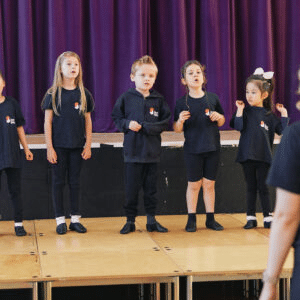
Play Versus Musical Etiquette Differences Parents Should Know
Plays and musicals share the same heart: arrive early, listen well, move safely, respect people and equipment. Musicals simply add music, mic handling, faster backstage traffic and one-side quick-change lanes.
| Area | Play essentials | Musical essentials |
| Sound | Project without mics. No extra noise backstage. | Mic on or off only when cued. No touching mic tape paths. |
| Music | Rarely applicable. | Respect band count-ins. Watch the conductor. No talk in the pit. |
| Backstage flow | Standard traffic. | One-side quick-change lanes. Faster presets. |
| Dressing room | Quiet, focused. | More costume pieces. Extra time for changes. |
| Cues | Fewer tech cues. | More light and sound cues. Stand by when called. |
For a musical with a small band and head mics, backstage traffic must be tighter, so we mark extra spike paths and rehearse mic checks. A straight play has no mics and fewer cues, so the dressing-room call is simpler. Both need discipline, but the musical asks more of the group on timing.
Safety pointer: ABTT (Association of British Theatre Technicians) guidance reminds young actors not to step on cables, to keep liquids away from headsets, and to watch for cue lights near the wings.
Auditions, Song Choices, And First Credits Without Tears
Confident auditions come from clear preparation, age-appropriate material, and small routines that calm nerves. Families can also ask our team about our in-house children’s talent agency, which current students can join free after a short audition.
Two-step audition checklist:
- Choose a song or short speech that fits the child’s range and age. Avoid songs that belt too high or run too long.
- Practise with a piano track, a clear cut and a start-note. Run it for timing, breath and stage directions like where to stand and how to exit.
Performance anxiety tips we use in class:
- Three-count box breathing.
- Feet grounded, soft knees.
- Smile briefly at a friendly person on the panel to anchor eye contact.
- One clear thought before you perform: the idea of the scene or the hope of the character.
Easy audition songs for kids, and why they work:
- Maybe from Annie. Short, clear melody, kind to young voices.
- I Just Can’t Wait to Be King. Energetic and age-fit, good for playful actors.
- Consider Yourself from Oliver!. Simple cuts, ensemble feel, helps group focus.
- Tomorrow from Annie. Best for older Star 2 and Star 3 children (ages 10+), if the range suits.
We rotate musical theatre songs for kids so material feels fresh, and keep a list of kids’ songs that sit well in the room for a quick win. If you are exploring screen work, ask us about chaperones, self-tape etiquette, permissions and rest rules. We keep life balanced so the world of performing stays fun and safe.
We run sessions across our five Spotlights venues in Beckenham, Bromley, Croydon, Orpington and West Wickham, with the same small classes, professional teachers and regular termly showcases at each.
Common Stage Etiquette Mistakes And How We Fix Them
The most common issues are late arrivals, talking backstage, forgetting to sign in, and crowding the stage door. We fix them with simple routines, calm reminders and practice.
- Late sign-in. We set alarms and a family travel schedule, and remind children to arrive five minutes early.
- Talking backstage. We use quiet hand signs and a standby reminder.
- Phone lights seen by the audience. We use sealed phone pouches.
- Ignoring the stage manager. We run a daily note review and role-play the cues.
We keep rules human: what went wrong, why it matters, and what to do next. This is where our roots show. Our founder Faye has used drama role-play to tackle bullying with over 10,000 pupils across the UK, and Spotlights has been a member of the Anti-Bullying Alliance since 2010, so kindness is built into how we correct mistakes.
Quick Reference Checklists For Cast, Parents, And Audience
Five basics for young performers:
- Arrive early and sign in.
- Wait quietly backstage and follow the stage manager.
- Treat costumes, props and instruments with care.
- Face the audience, use eye contact, and exit cleanly.
- Respect the stage door, security and everyone’s time.
Five rules of audience etiquette for families:
- Be seated before show time.
- No talk, no phone lights, no photography.
- Keep children on one side of the aisle and minimise walk breaks.
- Applaud at the right points and show appreciation at the curtain call.
- If you must leave, wait for a pause and follow the ushers.
Packing list for rehearsal and show night:
- Water and a small nut- free snack for breaks.
- Spotlights hoodie, hair ties, and jazz shoes you can stand and walk in.
- Pencil for notes and, if needed, your ticket.
Next Steps For Your Child
- Weekly classes for ages 4–18: Little Stars (4–7), Star 1 (7–9), Star 2 (10–12) and Star 3 (13–18).
- LAMDA exam preparation, taught by co-director Faye, who follows the LAMDA syllabus and whose students achieve consistently high grades.
- Our in-house children’s talent agency, free to current students after a short audition.
- A free, no-obligation trial class at any venue.
Stage etiquette is learned in layers: skills and kindness, timing and care. It is how young actors respect the craft, each person in the cast, and the audience who came to watch. To see it in action, come and visit a musical theatre class in Beckenham, Bromley, Croydon, Orpington or West Wickham. We will be ready, prepared and happy to help your child stand on stage with pride.
Book a Free Trial Today
Frequently Asked Questions
When should my child arrive for a performance?
Aim to sign in by call time, which is usually the half-hour call before the show. We ask cast members to arrive five minutes early to rehearsals too, so there is no rush to get prepared and no risk of missing cues.
Can parents wait by the stage door after the show?
Yes. The stage door is where families meet cast members. Find the marked area, wait patiently, and follow the venue route rather than backstage shortcuts. A quick thank you and some appreciation goes a long way, and please let actors leave when they need to rest.
What age groups do Spotlights classes cover?
We teach children aged 4 to 18 in small, age-grouped classes: Little Stars (4–7), Star 1 (7–9), Star 2 (10–12) and Star 3 (13–18). Every class is taught by professional, DBS-checked teachers, and new families can book a free trial at any of our five venues.
Spotlights Performing Arts Classes
We have a range of dance, drama and singing classes for children ages 4-18 years.
Find the best performing arts class for your child!