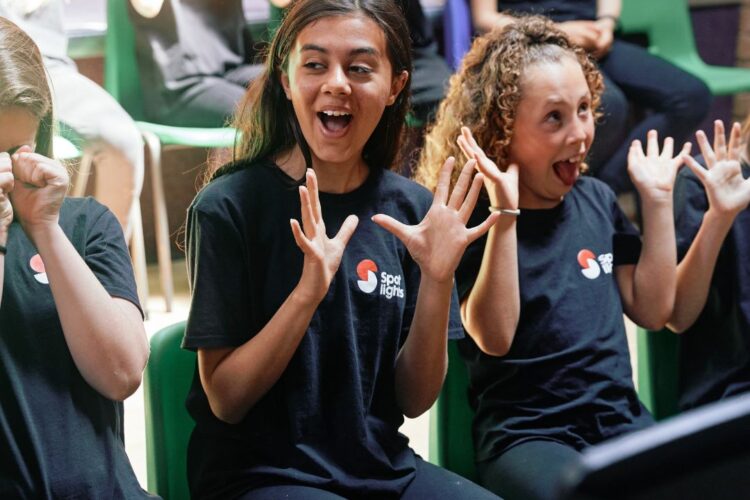

Diversity & Inclusion in Musical Theatre
Diversity and inclusion in musical theatre for kids means every child gets a genuine chance to sing, dance and act, whatever their background or ability. At Spotlights, we build this into how we teach, cast and structure every class, and we believe it’s something every parent researching drama schools in London should be able to see for themselves, not just take on trust.
What Does Diversity and Inclusion Mean in Children’s Musical Theatre?
Diversity and inclusion in children’s performing arts classes means welcoming performers of every ethnicity, ability, gender identity, and socioeconomic background, and giving each child equal opportunity to sing, dance, and act on stage.
This isn’t a new conversation for the wider theatre industry. Over more than a decade, commercial theatre has moved away from casting that reflects only one type of performer, towards ensembles that better reflect the world watching from the audience. Broadway and the West End have both seen a shift in this direction, with colour blind casting becoming far more common in musicals written decades ago that once relied on a narrower idea of who could play a leading role. Diversity in musical theatre is no longer a side conversation. It’s part of how the industry thinks about story, casting and who gets to stand on a West End stage or an arena stage at all.
This matters at every level, including for children learning to perform for the first time:
- Children from Black and minority ethnic backgrounds are statistically less likely to have been taken to arts events growing up than their white peers
- This creates a gap in confidence, exposure and opportunity long before a child ever sets foot in a drama class
- We see it as our job to help close that gap through how we teach, not just what we say
We built our STAR System around this idea: Self-confidence, Teamwork, Active learning, Realising potential. This framework links inclusion directly to our everyday teaching rather than treating it as a separate policy bolted on for appearances. It’s what shapes our classes day to day, and it’s the reason we talk about realising potential rather than simply teaching technique.
Why Inclusive Drama Classes Matter for Children’s Development
Performing arts as a whole is important in children’s development and inclusive performing arts training improves empathy, teamwork, and self-esteem in children. Mixed-ability groups and diverse casting make representation normal rather than exceptional, and that’s exactly what we aim for at Spotlights, whether a child is stepping onto a stage for the first time or working towards their next production.
Building Empathy Through Diverse Characters and Stories
Portraying diverse characters teaches empathy and a broader sense of the world. Musical theatre for kids regularly puts children in the shoes of characters from other cultures, races and time periods, and this is part of why musical theatre has such a long history of shaping how young people see the world.
The theatre industry’s own history offers plenty of examples worth exploring with students. During the golden age of musicals, shows like South Pacific tackled race and prejudice directly, at a time when many productions still cast almost exclusively white actors in leading roles. Decades later, The Lion King brought African storytelling and music to a mainstream stage, introducing a generation of children to a story that didn’t traditionally exist in commercial theatre.
A child playing a role outside their own background learns to see the world through someone else’s eyes, and we watch this happen in our own classes every term as children take on parts that challenge how they think about other people’s experiences.
Confidence Growth for Children From Underrepresented Backgrounds
Representation on stage boosts confidence for children from underrepresented groups, especially when there’s a real pathway beyond the classroom. Industry leaders across theatre have spent years fighting racism and pushing institutions towards more diversity in lead roles. Audra McDonald, a record-breaking Tony Awards winner, and Ali Stroker, the first wheelchair user to win a Tony, both stand as proof of what’s possible when producers and casting teams choose talent over tradition.
Performers of Asian descent, ethnic minorities and disabled artists have all had to fight harder than they should for the same stage time as everyone else, and their success has helped prove that diverse casting doesn’t just matter morally, it can also set box office records.
We give our own students a taste of that same opportunity:
- We run our own Talent Agency alongside our weekly classes
- Our agency has close relationships with leading UK child casting directors
- Our students have gone on to West End musicals, touring productions, pantomimes, film, TV and commercial work
This links straight back to what our STAR System promises: self-confidence and realising potential, in practice, not just in theory.
How Spotlights Theatre School Supports Diversity and Inclusion
As one of the best performing arts schools in London, we welcome children of all abilities aged 4 to 18. This shows up in practical, structural ways, not just in a mission statement on our website:
- We cap our classes at 20 students for personalised attention
- We split children into age-banded groups, from Little Stars (4 to 7) to Stars 1, 2 and 3 (7 to 18)
- We give every child a performance opportunity, every term
- We’ve been Anti-Bullying Alliance members since 2010
- We offer a free trial at all our weekend classes to remove entry barriers for new families
Our Anti-Bullying Alliance membership means we stay current on best practice around bullying and actively contribute to it, rather than simply displaying a badge. Keeping our classes small means no child gets lost in the crowd, regardless of background or ability, and our teachers get to know each student well enough to spot when extra support or encouragement is needed.
Diverse and Inclusive Casting in Children’s Productions
Inclusive casting practices give every child equal opportunity regardless of appearance or background. We cast on talent and suitability, not physical appearance, unless a trait is essential to the role. This approach echoes changes across the wider theatre industry, where colour blind casting has opened up leading roles once reserved for a narrower type of performer, and where productions increasingly reflect a broader idea of who belongs in a cast, or on a stage in front of paying audiences.
Our casting decisions are guided by three principles:
- Colour-conscious casting
- Gender-inclusive roles
- Mixed-ability ensembles
We think this matters not just for one show or one season, but for how a child comes to see their own place in a story. When every child, from dancers to actors to singers, has a genuine chance at a meaningful part, casting stops being something to worry about and becomes something to look forward to.
What inclusion looks like at Spotlights
Every performing arts school says it’s inclusive. Here’s what it means in practice at Spotlights:
- Children aged 4 to 18 learn in age-banded groups small enough for every teacher to know every child. Nobody sits on the sidelines: every child performs every term, whatever their experience or confidence.
- Weekend classes come with a free trial, so families can see how a child settles before they commit.
- Because cost is the biggest barrier of all, we work with local primary schools to offer fully funded scholarship places to children who would otherwise miss out — places that come with everything the paying families get, including the shows.
Access and Affordability: Removing Barriers to Musical Theatre
Financial and access barriers keep many children out of musical theatre altogether, and the numbers behind this are worth pausing on:
- Only 26% of 5 to 10 year olds and 54% of 11 to 15 year olds engaged in theatre and drama activities in 2019/20
- Low-income families are disproportionately missing out
- School trip access to culture dropped 68% for disadvantaged intakes, versus 44% in affluent areas
Our fees are published in full on our fees page, with everything a child needs for weekly classes included, the only extras are a one-off uniform and tickets for our annual theatre production for 7-18 year olds. For children who’d otherwise miss out, our scholarship places with local primary schools are fully funded. Against a national picture of shrinking access, we think that kind of transparency matters, and it’s one of the clearest ways a local drama school can put its values into practice rather than just talking about them.
Bringing Diversity and Inclusion to Life at Spotlights
When you’re choosing musical theatre training for your child in London, look for:
- Small class sizes
- Mixed-ability inclusion
- Anti-bullying commitments
- A performance opportunity for every student, not just a few
We build all of this around one STAR System philosophy, from our Little Stars classes right through to Talent Agency placements. You’ll see it in our mixed-ability casting, our Anti-Bullying Alliance membership since 2010, and a free trial at every weekend venue. We’d rather show you what inclusion looks like in one of our classes than simply tell you about it, and we hope every family who walks through our door, whatever their background, leaves feeling like they belong here.
With small groups, experienced industry teachers and the chance to perform every term, our musical theatre classes for kids in London give young performers the space to grow in confidence, skill and creativity. If your child is ready to give it a try, a free weekend taster is the perfect place to start.
Book A Free Trial
FAQs
Which course should I choose if my child has never performed before?
Start with a free trial at one of our weekend classes in the age-appropriate class, either Little Stars or Stars 1, 2 and 3. There’s no need to wonder whether your child is ready. Our teachers assess ability in the room, not before they arrive.
Do all children get cast in a leading role at some point?
Not every child plays a lead in every scene, but every child is cast in a meaningful part each term, past productions included. We look at each child’s growth over time, not just one performance.
How do parents from different backgrounds feel their children are represented at Spotlights?
Parents consistently tell us their children feel represented in our casting and classroom, whatever background they come from. That feedback shapes how we plan every future production, not just the current season.
Spotlights Performing Arts Classes
We have a range of dance, drama and singing classes for children ages 4-18 years.
Find the best performing arts class for your child!